CPA vs. CPS: Understanding The Different Affiliate Payment Models
A complete guide to CPA (Cost Per Action) and CPS (Cost Per Sale) models. Learn how they work, their key differences, and which one drives better ROI for your affiliate marketing strategy.
27-Mar-2026
Share
The affiliate marketing industry is experiencing significant growth, with industry estimates projecting revenue of $62.27 billion by 2033. This way, a business generates revenue by driving online sales of products and services. However, as an advertiser, you must select the right payment models to build a moat around your affiliate program and maximize your budget’s effectiveness. It requires a delicate dance of balance between CPA and CPS models that eventually emboldens your program.
It is seen that on certain occurrences, advertisers complain that their budgets are depleting, clicks are flooding in, yet conversions do not seem to fall in place. When these models fail to align with your business objectives, they may not generate the required ROI. Furthermore, these models will not only reflect on how affiliates are paid, but they will also shape partner behavior, influence program economics, and impact campaign timelines, making them crucial for the long-term success of your program, which remains scalable as well. The use of these models must ensure that every penny spent delivers measurable outcomes. Marketing campaigns do not have a universal payment model, and businesses must optimize models to increase their ROI.
Let’s examine two of the models in detail, namely CPA and CPS, to help you determine how these approaches help you achieve your marketing goals.
What Is a CPA?
The Cost Per Action model is a basic, quick-win performance marketing model where advertisers pay a fixed commission amount to affiliates for every action performed by users on the advertiser’s landing page.
The advertiser predetermines these actions, which users undertake, and they are as follows:
- Filling out a form
- Signing up for a newsletter
- Downloading an app
- Watching a video
- Subscribing to a service
- Engage in Email submissions or ZIP code submissions
- Free trial registrations
- Requesting a quote
- Creating a new account
- Booking a consultation
To get the most from this model, advertisers must delve into their audience's pulse for a deeper understanding of their behaviors. It will help them create compelling and targeted content, encouraging their users to take action. As speed is the name of the game here, high-volume campaigns that generate immediate conversions are considered the best choice for this type of model. The real draw? Affiliates do not need to persuade users to buy the product; rather, they get incentivized when customers complete an action, making this model quite desirable and addictive among marketers. Nor do affiliates need to make efforts with a difficult sell. It is that simple and powerful shortcut strategy that guarantees short-term pushes or increasing brand awareness among users. This approach is useful especially for those brands that are building their communities or increasing their follower counts.
The strategy allows you to bypass the gradual process of establishing long-term trust with users and accumulating results in favor of a shorter conversion journey that tracks and keeps acquisition costs under tight control.
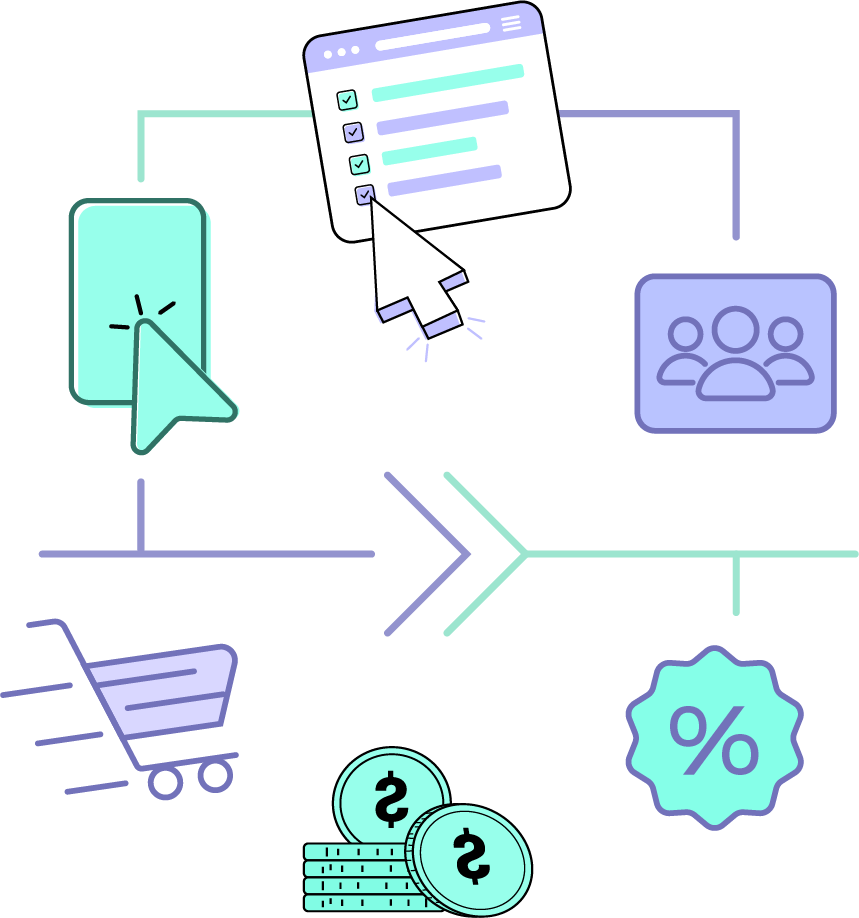
CPA Funnel Breakdown:

In CPA marketing, affiliates and media buyers drive traffic to the advertiser's offer page, and they receive rewards upon successfully completing the required action.
Example 1 for CPA:
Let’s say some users are interested in discounted hotel bookings and travel deals. As an affiliate, you must strategically place booking widgets and call-to-action buttons on your website, such as in customer and hotel reviews, travel guides, blog posts, or on the homepage. For every booking made through your website, you, as an advertiser, pay affiliates, thereby generating a steady income for them.
Example 2 for CPA:
If an advertiser pays $60 per action and an affiliate generates 10 actions, then:
Total Earnings = Cost Per Action × Number of Actions
Total Earnings = 600 × 10 = $600
This calculation means the affiliate earns $600 for driving 10 successful actions.
What is a CPS?
Cost Per Sale is where affiliates' on-paper ideas, strategies, plans, and promises turn into fruition. Empty rhetoric, organic clicks, signups, or form submissions won't suffice to earn an income. CPS operates as a performance marketing model, where the advertiser compensates affiliates with a fixed commission for generating sales through their website or platform.
It is here where affiliates’ persuasive skills make all the action happen by first driving traffic to the advertiser’s landing page, and then they subsequently do all the heavy lifting of converting the audience's interactions into an actual sale.
The model maintains its focus on the finish line, ensuring accountability for every dollar spent. Thus, it eliminates the risks of paying for clicks and impressions that do not end up in actual sales. At the end of this process, affiliates get a percentage of each successful sale they have generated.
CPS Funnel Breakdown:

CPS drives high-intent traffic, usually through SEO content, review sites, comparison platforms, or a loyal audience built over months or years. Once the audience warms up with the content, they are exploring product page details in terms of pricing, customer reviews, and product real-time benefits. This process strengthens their buying intent and convinces them to move to the checkout page and purchase the product, and the affiliate is duly rewarded with commission.
Example 1 for CPS:
The eCommerce store partners with a popular influencer who has a wider fan following interested in fashion trends. The influencer publishes detailed blogs and reviews of brand new collections, creates snazzy images, and adds a unique affiliate link to his posts. When his subscribers, who show a keen inclination toward influencers' content and his recommendations, click on the link and make a purchase, the influencer receives a certain percentage of the sale amount.
Example 2 for CPS:
If an advertiser offers 10% commission per sale and an affiliate generates 20 sales, with each product priced at $900, then:
Earnings per Sale = Product Price × Commission %
Earnings per Sale = 900 × 10% = $90
Now,
Total Earnings = Earnings per Sale × Number of Sales
Total Earnings = 90 × 20 = $1800
This calculation means the affiliate earns $1800 for driving 20 successful sales.
How Do CPS And CPA Differ From Each Other?
These payment models differ in payment amount and frequency, apart from their dry definitions. CPS payments are typically higher, resulting in a substantial payout, but they require a longer commitment to the affiliate program compared to the quick rewards of CPAs. Sales are akin to climbing a steep mountain, as compared to filling out a form or clicking in the case of CPA. However, isn’t it true that the thrill of a large commission amount is worth the wait? Well, yes, it is!
Why Does Someone Choose CPA over CPS?
Advertisers get more wiggle room in CPAs, where they define the actions that users must undertake. Thus, it is a more targeted approach, as you decide to pay for what seems in line with your business objectives.
CPA is a less risky affair as the advertiser pays for their desired actions. Moreover, it also increases a brand's reach and awareness to a wide spectrum of audiences who may not be purchasing a product for now but can be converted into loyal customers in the long run. However, at the current juncture, something of interest and value may entice them.
What Holds Value for the Advertisers?
Can campaigns be tailored to meet the dynamic needs and preferences of advertisers? Well, certainly, yes. As an advertiser, you can fine-tune landing pages, offers, and creatives as part of your ongoing action. With robust analytics and reporting, you can opt for those actions that deliver maximum value and optimize the campaign for maximum effectiveness through data-driven decisions.
What Holds Value for the Affiliates?
Well, affiliates monetize from increased traffic and captivating content that appears relevant to users. Here, affiliates act based on their discretion, whereby they choose those offers and opportunities that benefit their platforms and users.
What Holds Value for the Customers?
Even customers are the biggest profit-making entities here. They need not shell out anything for performing certain actions that actually interest them and are of real value. Isn’t it an enticing model? Well, it is! The CPA model also provides its customers access to a basket of valuable content and resources, where they can take any action of their choice based on the content they consume or engage with and the resources that best meet their needs and expectations at that very moment. Furthermore, CPA is a cost-effective model where you allocate your budgets prudently towards those actions that have a high likelihood of conversion and that can produce a higher ROI.
Why Does Someone Choose CPS Over CPA?
Beyond the white noise and clutter, it is the silence of the tangible revenue that stands out. CPS advertisers meticulously allocate every penny of the budget to actual conversions. Strategically deploying the budget to instigate real growth prioritizes the bottom line.
Brands maintain firm control over costs by managing their expenses and preventing wasteful ad spending, unlike CPA. The model is scalable, allowing for the expansion of efforts to reach a larger audience and drive more sales.
What Holds Value for the Advertisers?
Advertisers bear the primary responsibility for conversions, as they must ensure that affiliates attract high-quality traffic and optimize their efforts to generate sales. Ultimately, the payments made to the affiliates directly correlate with the sales. Advertisers only pay their affiliates in case a sale occurs; hence, risk is mitigated to a larger extent in terms of reduction of wasted ad spend on non-converting offers.
The result? It includes a higher proportion of customers who are genuinely interested in your product and are, therefore, more likely to engage with you rather than just having occasional interactions. CPS guarantees payout, making it a more predictable, measurable, and efficient approach. One more major upside for advertisers in CPS is that the revenue earned is the outcome of a long-term nurturing relationship with customers. By working with loyal, high-value customers, you can scale earnings through repeat purchases and a sustainable income stream, instead of depending on one-off sales.
Furthermore, payouts are higher per transaction, though conversions take their own sweet time. Moreover, campaigns are easy to track, as advertisers only pay when there is a sale. It allows advertisers to calculate their ROI easily and adjust their advertising campaigns accordingly.
What Holds Value for the Affiliates?
The model remains lucrative for affiliates, where they are incentivized with a higher commission for every sale. Hence, they can capitalize through this model to cover a gamut of income sources, which begets more sales. They control the conduct of promotions and the content included in their campaigns. They also present high-quality products to visitors to boost sales volume.
Additionally, the model is premised on building a long-term relationship with customers to effect a sale. If not on an immediate basis, then eventually they will return over time. Hence, advertisers rely completely on the credibility and trustworthiness of their affiliates to generate sales. Therefore, affiliates play a significant role in this scenario.
What Holds Value for Customers?
Lastly, the customer gets the larger piece of the pie, where they get benefitted with their desired product in hand. Additionally, the model saves them significant time and money by enabling them to easily compare various products and services online. Their shopping journey concludes when they purchase a product or service they trust and rely on, based on affiliates' recommendations and reviews.
Conclusion:
Which model appears to be the sweet spot here for your business? There is no definitive answer to this question. It depends on the characteristic traits of your products and services. "Is your business thriving on a diet of higher conversion rates, juicy profit margins, and low refund rates?" Then CPS becomes the best bet. These include eCommerce brands, subscription products, digital products, and SaaS-based products where your focus is on more substantial returns.
Conversely, if your business relies on thin profit margins, low conversion rates, and high refund rates, you should choose CPA. These include mobile apps, gaming and finance-based products, subscription platforms, and utility tools. Here, you are meeting your pressing needs rather than realizing larger gains.
Do the size and quality of your target audience determine the choice of your model? Well, certainly, yes. CPS is effective for niche markets with high demand, a larger customer base, and low competition. CPA, on the other hand, caters to saturated markets with less demand and high competition. Moreover, CPA attracts more beginners simply because it is a frictionless model.
Lastly, it is the balance of risk and control that determines which way the winds will blow. CPS is a high-stakes game, risky, and proves to be rewarding. Why? This is because payment is tied to the sale, and both parties have less control over the outcome.
Consider this: once the click occurs, the actual sale depends on various factors.
- Quality of the product or service
- The effectiveness of customer service
- Does the landing page convert or confuse the audience
- Is the pricing competitive?
CPA, on the other hand, is a steadier path, which is less risky but less rewarding for both parties, as less commission is paid here to affiliates for every action. The outcome of CPA is significantly influenced by the offer, the ad, the traffic source, and the conversion rate.
But here’s the trade-off: who holds a more dominant position? Choose the CPS model for a bigger payout and the CPA model for smaller, guaranteed gains.